Some people come into your life to teach you how to live it — the whys, the whats, the hows, and just as often, the why-nots and the how-not-tos.
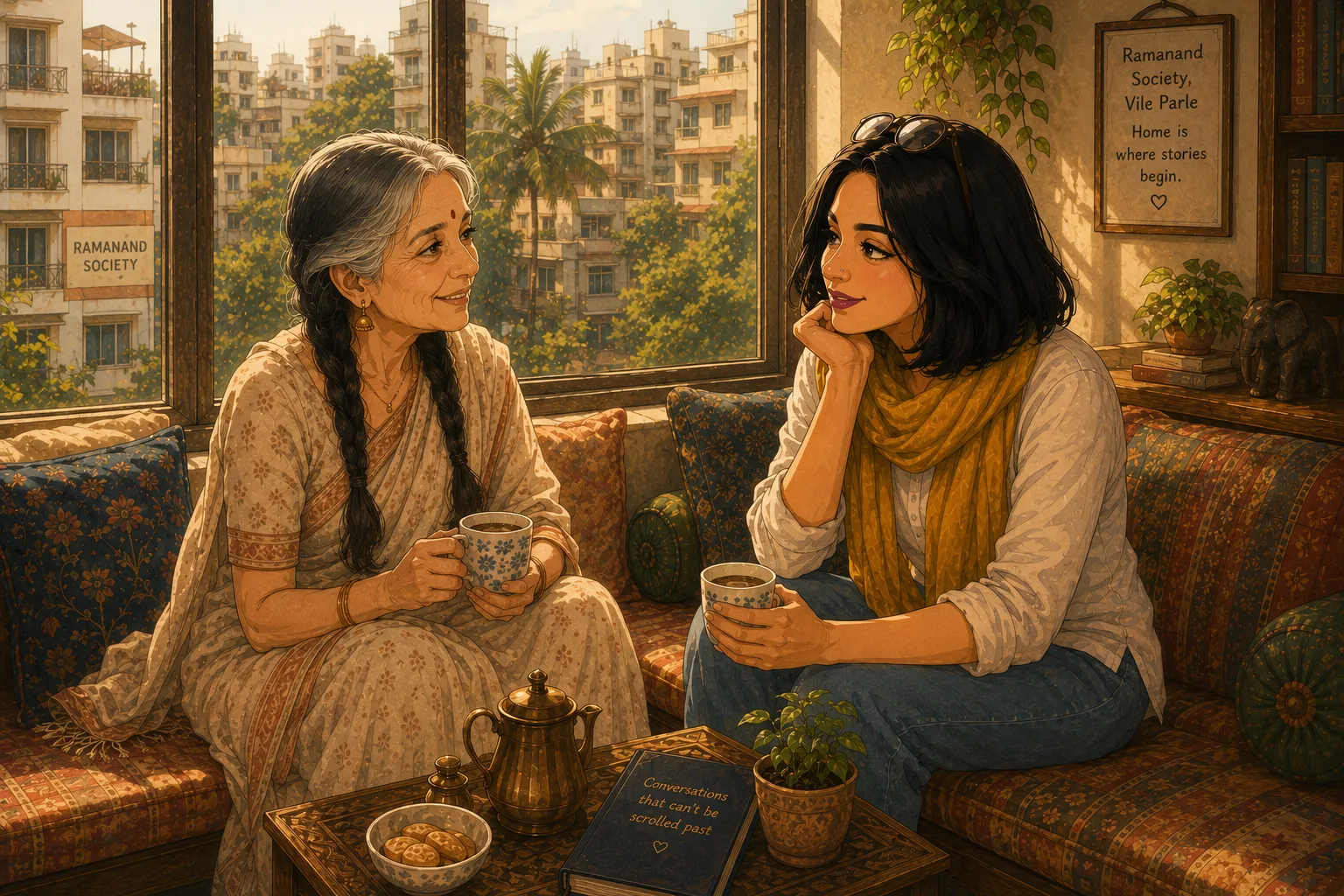
When I left home for university, I moved in as a paying guest with a newly widowed woman in her sixties, Mrs. Sunita Parchure. She lived alone in a one-room-and-kitchen flat in Ramanand Society, a well-known residential complex in Vile Parle.
It was a steep learning curve. I had never lived anywhere without my parents, and part of the point was to put real distance between myself and my comfort zone — to live in the world without a safety net.
She was newly widowed, still finding her footing in the reality of losing her husband, and I arrived as a ready-made project for her to take on. She folded me under her wing less like a surrogate daughter and more like a student — teaching was the only role she had ever really known, having done it her whole life. She had no children of her own, so motherhood was uncharted territory for her too. We built our own rules for whatever this relationship was going to be.
I called her Aaji — grandmother — and she was happy to answer to it. True to her years as an educator, she believed in throwing her students straight into the deep end, but she also made sure she was standing on the shore with a life jacket, just in case.
She taught me to cook simple, everyday meals. I ran her errands. In exchange, she gave me a roof, one meal a day, a bed, and a small cabinet to call my own — all for a modest rent.
My days fell into a rhythm: mornings and afternoons at college for classes and lab sessions, lunch at my cousin's place, and then, by four in the evening, over to Aaji's. I'd bring her groceries on the way, tell her about my day, and listen to hers — or rather, to her past. She came from a wealthy landowning family, and she told me stories of the servants who once ran her household, the enormous home she grew up in, and the life she'd led as a young woman. You could still see it in her face — she had been a strikingly pretty woman once. Age hadn't been kind to her, but it hadn't erased the evidence either.
I opened up to her too, drawn in by her appetite for life and her generosity of spirit — except, pointedly, when it came to money. There she turned fiercely frugal, sending me the extra mile to find groceries a few rupees cheaper, even though she and her husband had built a comfortable pension and a small fortune over forty years of work between them. I learned plenty about running a household from her. I never did adopt her save-every-rupee-for-a-rainy-day philosophy. Even now, some of the traditional Indian dishes I cook still taste like hers.
She became my confidante. She knew about my boyfriend before anyone in my family did. In return, she told me everything — her old office crushes, her family dramas, her lifelong friendships — until eventually I was friends with all of them too. Somewhere in those stories, my mind was quietly assembling some of my first independent views of the world.
She grew possessive of me, and she'd throw a small tantrum if I was ever late coming back from college. She always kept a small gift on hand for anyone visiting her for the first time — a habit I picked up from her and still practice today.
Aaji passed away in 2018. I still remember every one of her quirks and virtues as clearly as if I'd seen her yesterday. Some people enter our lives without the excuse of blood or choice — they simply happen to us.
What began as a platonic situationship became something that has outlasted her lifetime. And with this writing, maybe it outlasts mine too.