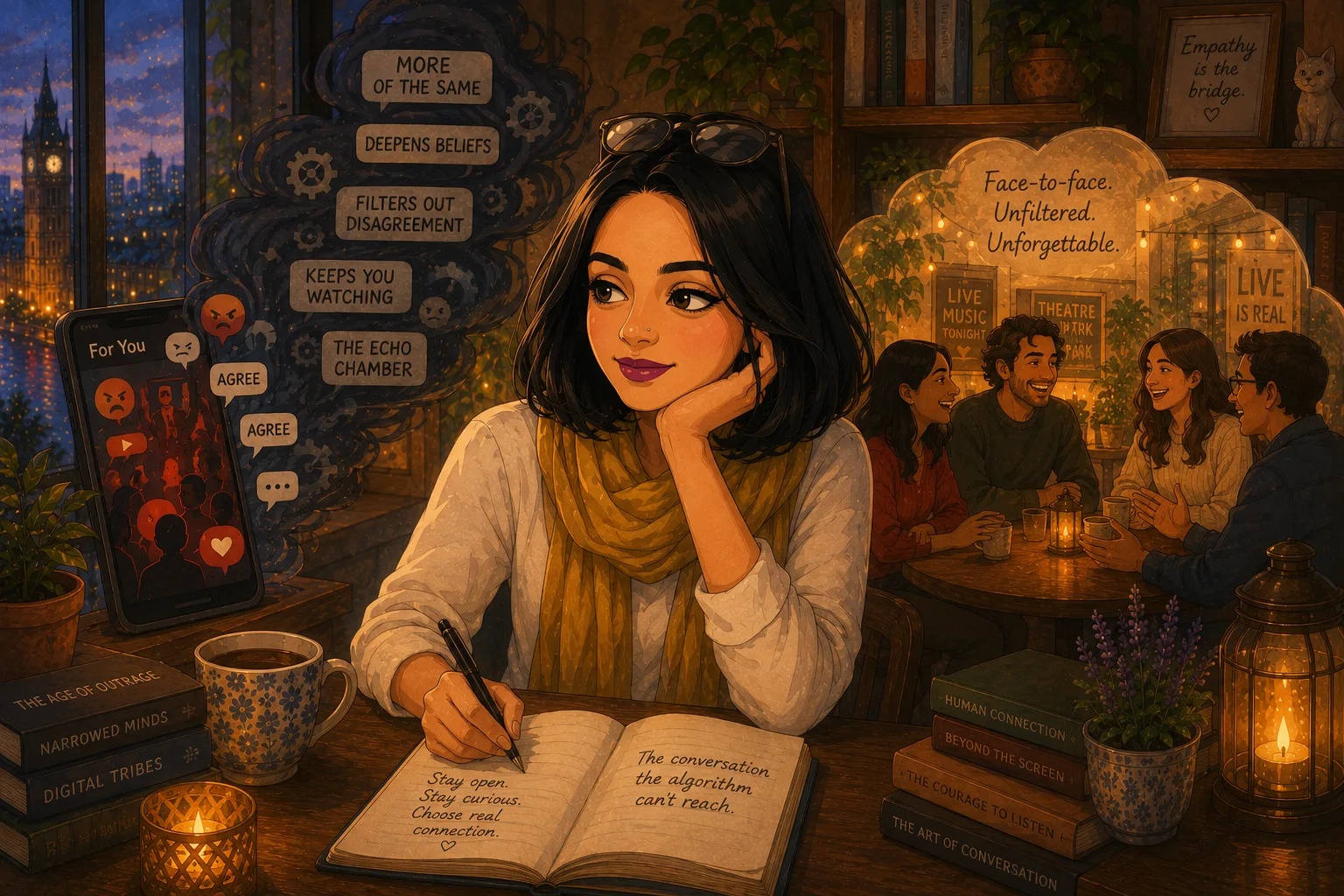
A Culture Pulling in Two Directions
We live in an age that prides itself on becoming more sensitive, more inclusive, more aware. Words once used casually are now retired from everyday vocabulary, deemed unfit for a culture that has learned — rightly — to consider whose feelings and dignity are at stake. This is the visible face of what is loosely called the "woke" movement: a slow, deliberate effort to widen our circle of empathy and to make room for people and perspectives that were once ignored or mocked.
At the very same time, and often on the very same screens, a quieter and more powerful force is at work. Every platform we open studies what we click, linger on, like, and share, and then feeds us more of exactly that. The algorithm does not have an agenda of tolerance or intolerance — it has only one goal, which is to keep us watching. In pursuing that goal, it does something curious to our minds: it deepens our existing beliefs, sharpens our existing preferences, and quietly filters out the discomfort of encountering a view unlike our own.
Here, then, is the contradiction at the heart of modern life. One force is actively trying to make us broader-minded. The other, operating beneath our notice, is making us narrower. And both are unfolding at the same time, on the same devices, often within the same scrolling session.
The Irony Inside the Movement
The deeper problem is that the woke movement itself has no channel of expression outside the digital world. Its calls for awareness, its corrections of language, its campaigns for inclusion — nearly all of it travels through the same social platforms governed by the same engagement-driven algorithms. The very tool meant to spread tolerance is built to reward the tribe, not the bridge.
This creates a real risk: that the push for greater openness ends up trapped in its own echo chamber, preaching fluently to those who already agree, while remaining invisible — or worse, alienating — to everyone else. A movement built to dissolve intolerance could, without meaning to, calcify into just another walled-off camp, unaware of how it sounds to those outside it.
So what breaks this loop? Not another app, not a smarter feed. What breaks it is the oldest technology we have: sitting across from another human being. Face-to-face interaction forces us to listen in real time, to see a reaction we cannot swipe away, to stay in a disagreement long enough to actually understand it. It is slow, occasionally uncomfortable, and impossible to algorithmically optimize — which is exactly why it works. It is the one remaining space where an echo chamber cannot follow us in.
Why the World Is Rushing Back to Live Events
This helps explain a trend that, on the surface, looks unrelated: the surging appetite for live events — concerts, festivals, sports, live theatre — even in a world where every form of entertainment is a tap away. It is not a coincidence. It is a quiet rebellion against digital clutter, a hunger to experience something with all five senses rather than the two the internet knows how to serve.
Elon Musk put this shift into words in a recent interview, observing that once digital media becomes ubiquitous — available to anyone, anywhere, instantly — the truly scarce commodity left is the live event. What cannot be streamed, copied, or infinitely reproduced becomes the thing worth paying a premium for.
It is a striking reversal. Live, physical, face-to-face interaction was simply the default setting of human life until only a couple of decades ago; nobody thought of it as premium, because there was no alternative. Now the alternative is everywhere, and the original has become the rarer, costlier experience.
Where This Leaves Us
Two futures seem to follow from this. Large-scale, elaborate, unmissable experiences will increasingly happen in the physical world, priced and treated as premium. Everything smaller in scale — the everyday, the routine, the incidental — will keep defaulting to digital.
The question this leaves for each of us is a personal one: in a world where our feeds are built to agree with us and even our best intentions travel through the same narrowing pipes, how do we deliberately choose the room, the table, the conversation that the algorithm cannot reach? That choice, increasingly, may be the only reliable way left to stay open, tolerant, and genuinely curious about a mind unlike our own.