I was born and raised in India, and I have always worn that fact with quiet pride — not the loud, chest-thumping kind, but the deep, settled kind that comes from growing up immersed in something extraordinary without quite realising how extraordinary it is. Our culture is layered in ways that take a lifetime to peel back: the geometry of a rangoli pattern drawn freehand at dawn, the particular way henna dries and darkens on skin, the alchemy that happens when whole spices hit hot oil. I grew up inside all of this, and somewhere along the way, it became part of how I see the world.
I have always been a student of art in the most informal, personal sense. Not trained, not credentialed — just curious and willing to try. I have bent over sheets of paper with henna cones, attempting the fine latticework of traditional designs. I have stood at a canvas and painted. I have sat on the floor and laid down rangoli patterns from memory, trusting my hands to remember what my eyes had absorbed over years. And I cook — not always, and not when it feels like a task to be dispatched, but when there is time and space to make it a pleasure rather than a chore.
It was in that spirit that something caught my attention earlier this year.
During a Republic Day special episode of Masterchef India 2026, two sisters from Mathura made something that stopped me mid-scroll. They had prepared pakodas — those gloriously crisp, deep-fried fritters that are as essential to Indian cuisine as chai and conversation — but what they did with the plating was something else entirely. Four chutneys, piped in careful arcs and swirls around the plate, forming a mandala. The pakodas arranged within it like marigolds in a rangoli. Food as devotion. Food as geometry. Food as art. It was one of those moments where you think: of course. Why has no one done this before? Or perhaps they had, and this was simply the first time I had seen it.
I was impressed. More than that — I was inspired. And I began waiting, quietly, for the right moment to create my own version.
The complication was this: I have a complicated relationship with deep frying. I respect it, I appreciate it in others, but I cannot quite bring myself to centre a dish around it when I am cooking for an occasion. Old habits and health convictions die hard.
Then the right moment arrived, wrapped in a work email.
A flier about World Culture Day. A potluck lunch. An invitation to bring food from your own culture. I felt something click into place.
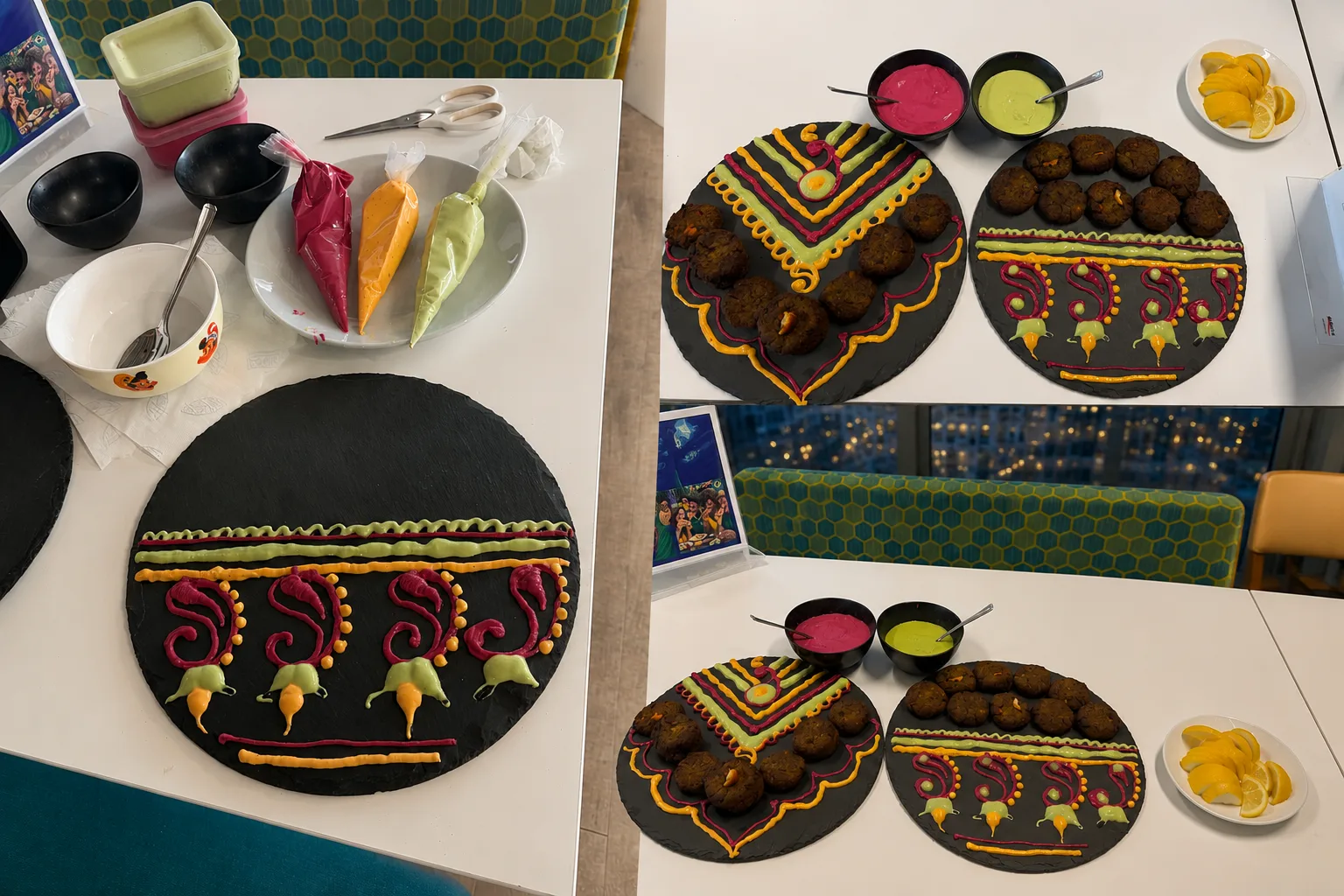
I decided to make Hara Bhara Kabab — a restaurant favourite across India, vibrant green from spinach and peas and coriander, substantial from potato and paneer, spiced just enough to be interesting. Fried, yes, but shallow-fried; texturally satisfying without the heaviness. For accompaniments, I made three things from scratch: a beetroot-peanut chutney, deep magenta and earthy-sweet; a mint and coriander chutney, intensely green and sharp; and a vegan pirinnaise — vegan mayonnaise lifted with piri piri seasoning — pale, creamy, with a slow warmth to it. Not a single jar opened, not a single shortcut taken. It took around eight hours from the first chop to the final plate. I did not begrudge a single one of them.
But the plating was where I made it mine.
I thought about those sisters from Mathura and their mandala. I thought about mehendi — henna — and the intricate, precise, endlessly patient art of applying it: the way a single fine line can suggest a leaf, a petal, a peacock feather. I mixed the chutneys with hung Greek yogurt to give them body and piping consistency, then loaded them into piping bags and drew traditional mehendi patterns directly onto the plate. The kababs were arranged within the design, not randomly but deliberately, the way flowers are placed in a garland.
I chose black slate serving plates and bowls. Deliberately, for the same reason a painter chooses a particular canvas — black slate is quiet. It does not compete. It holds the colour, it makes the green pop and the magenta sing and the cream settle softly between them.
I am not naive about what it means to cook food from your culture in a country that is not your own. I know that perceptions of India can be a complicated, sometimes frustrating thing — shaped by what western media chooses to spotlight, flattened into clichés or frozen in time, more concerned with a version of India that no longer exists, or perhaps never did. I am always conscious, in those spaces, that I am not just a person who brought lunch. I am, in some small unofficial way, a representative. Not in any grand, political sense — just in the ordinary human sense that what I put on that table will form part of someone's impression of where I come from.
So I wanted the food to say something true.
Not just that Indian food is delicious — though it is. But that it is also thoughtful. That it carries within it centuries of artistry, of colour theory and pattern-making, of a culture that has always understood that beauty and nourishment are not separate things. That today's India is not only its past but also two young sisters from Mathura who look at a plate and see a canvas.
What I laid on that black slate was, to my mind, a small and sincere portrait: food, culture, and art — not as museum pieces, but as something living, still being made.