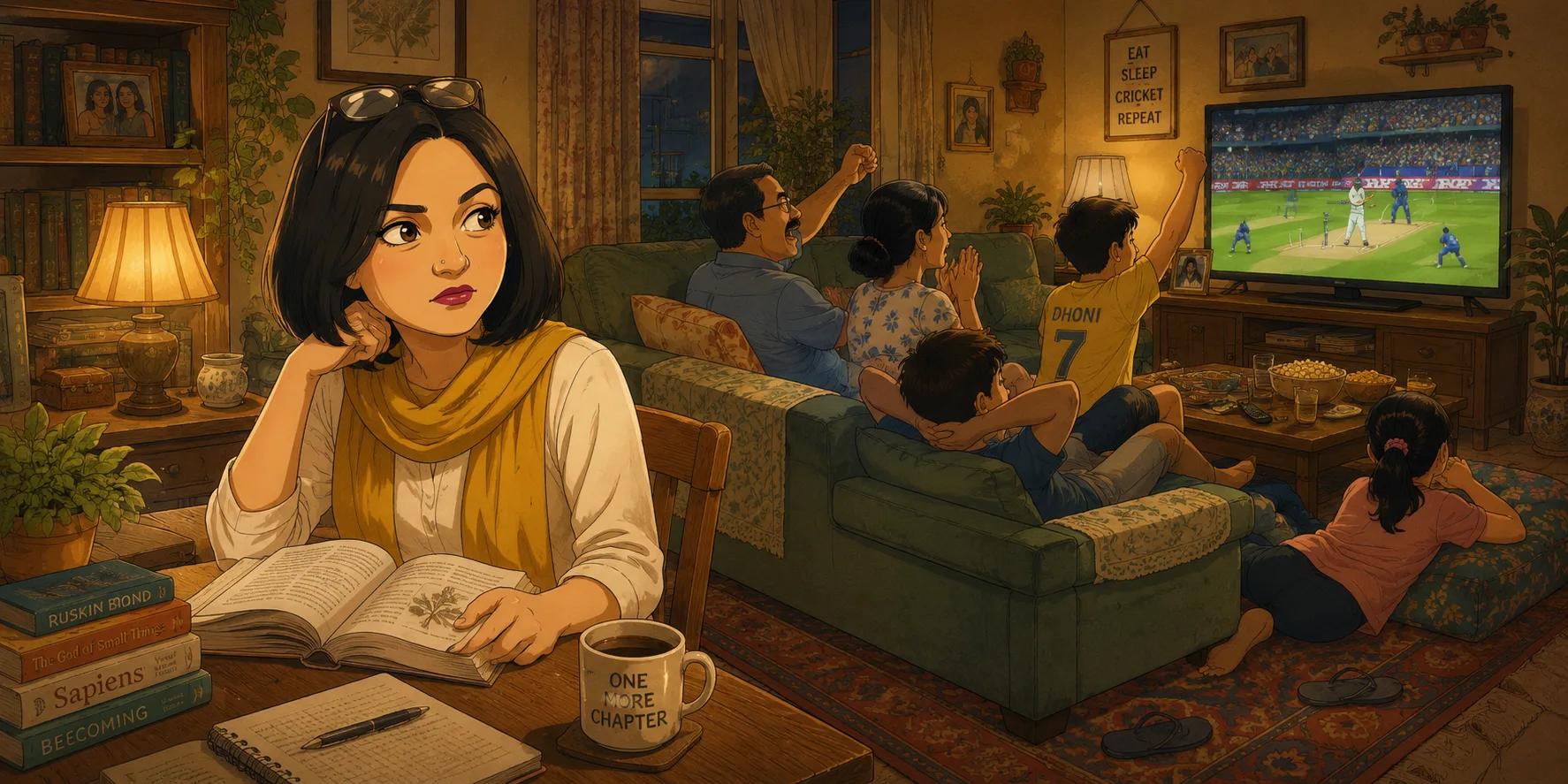
It's IPL season again. My family — die-hard cricket fans, every last one of them — has migrated to the sofa, where they will remain, more or less, for the next two months. Any match, any teams, any city: it doesn't matter. The television is on, the snacks are out, and the world has shrunk to the dimensions of a flatscreen and a chilled glass of beer.
For me, it's that time of year too, but in a different way. It's the season when I find myself quietly wondering — again — how one settles in to watch tiny figures dotted across a far-off ground, sprinting in the merciless Indian summer, sweating through their coloured kits, while we, the audience, recline in air-conditioned comfort. There is my family on one end of the spectrum, horizontal and untroubled, beer in hand. And there I am at the other end, upright and bewildered, my book open but unread, watching them watch the game.
That's where the wondering begins. At what point in our long history did we collectively decide that the highest form of leisure was watching other people work? Is it some lingering echo of older instincts — gladiators in the arena, knights at the joust, crowds with bread and wine cheering on someone else's exertion? We call ourselves the most awakened, most enlightened generation yet, and still our favourite Sunday pastime is fundamentally medieval. I know this is an unpopular thought. I've turned it over more times than I can count.
Some of it, I suspect, has to do with how I grew up. I was a track and field athlete — 100m and 200m sprints, relays, shot put, discus. That was my world. I knew the particular ache of a body pushed past its comfort zone, the metallic taste in the back of the throat after a hard sprint, the smell of liniment and freshly-cut grass before a district meet. I knew long afternoons of training that bled into evenings, the slow accumulation of seconds shaved off a personal best.
So when I watch players running on a field today, what surfaces isn't the drama of the match — it's my own memories. My teammates and me helping each other stretch after practice, taking turns to mix everyone's energy drinks, holding the stopwatch as someone tore down the track trying to chip a tenth of a second off their time. Trooping to the sports shop together to buy new spikes, comparing them, breaking them in. That, to me, was what sport felt like. It was something you did with people you trusted, working towards something hard, together. Sport wasn't an image on a screen; it was a smell, a soreness, a Saturday morning.
With no part to play in what unfolds on the television — no skin in the game, no body in the heat — the spectacle slips past me. It just isn't woven into my core sense of what sport is.
Live matches, though, are something else entirely. The stadium has its own weather system. Thousands of voices rising at once, the floor humming beneath your feet, the strange and lovely feeling of being briefly absorbed into a crowd. I have cheered with a hoarse throat and a racing heart as the home team made a goal, made a run, made a stand. There is a kind of purpose in it — you can almost convince yourself that your voice, added to the thousands, is travelling down to the pitch and lifting someone's morale by a small but measurable amount. Maybe it is. I like to think so.
Maybe one day I'll learn how to feel that same charge coming through a television set. For now, while my family settles in for another evening of slow-motion replays and earnest commentary, I think I'll quietly retire to my bedroom with a book, the muffled cheer of the lounge drifting under the door — close enough to feel like company, far enough to feel like peace.