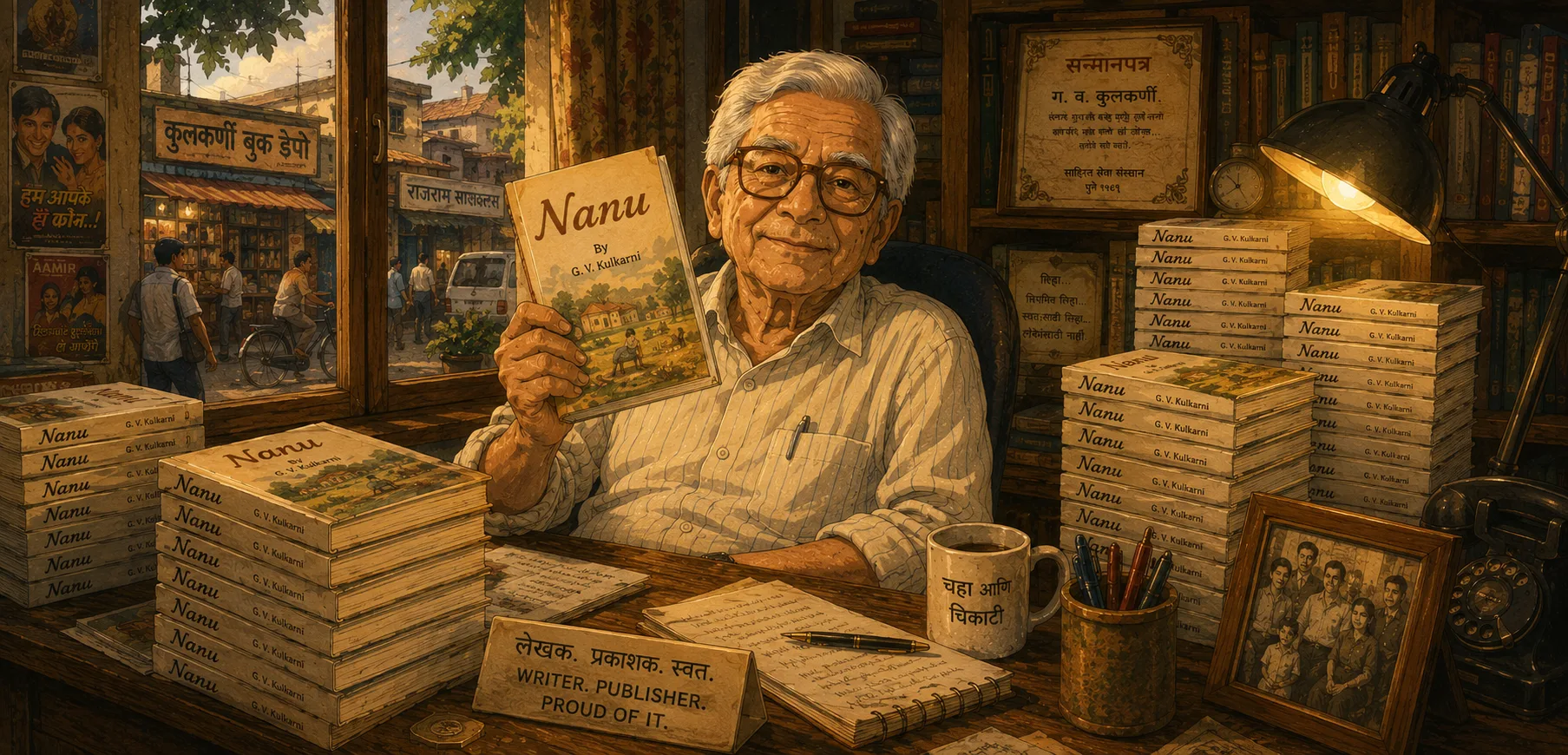
There are two meanings of the word Nanu in my life. The first is the Hindi word for maternal grandfather. The second is the title of a book — a book my grandfather wrote, self-published, and unleashed upon an unsuspecting world with tremendous pride and absolutely no quality control. These two meanings are, in my life, inseparable. You cannot say one without the other arriving uninvited, pulling up a chair and refusing to leave.
Let me explain.
I was thirteen years old when my Nanu published Nanu. This was, by any measure, a significant event in our family. My grandfather had carved out a reputation for himself as a hard-hitting journalist in his district — a man who wrote with conviction, pursued stories with tenacity, and was not afraid to say what others wouldn't. He had gravitas. He had standing. He was, in the community, a Serious Person.
He was also, it turned out, something else entirely. But we'll get to that.
The book launch was an occasion. My grandfather had called in every favour and connection available to him, and the guest of honour was none other than Laxmandas Pathare, the sitting Member of Parliament, who showed up in person to lend the whole enterprise an air of political legitimacy. There were garlands, there were speeches, there were folded hands and respectful nods. The first print run was seven or eight hundred copies — not a small number for a self-published debut in small-town Panvel in the mid-nineties.
I still remember the moment the book was unveiled. My grandfather's sisters were there. My mother was there. As the cover was revealed, the women in the room had tears in their eyes — genuine, glittering, happy tears. There was the kind of collective pride that settles over a family when one of their own has done something remarkable. My grandfather stood at the centre of it all, beaming.
It was, genuinely, one of the loveliest things I had ever seen.
And then people started reading it.
Now, here is where I must pause to deliver some important context. Of everyone in our family — and I want to be clear that this is a reasonably large family, spread across multiple generations — I am the only one who has actually read Nanu from cover to cover. Every last word. I did this as a teenager, which was probably not the intended demographic, but more on that shortly.
The book, I can report with the authority of a sole surviving reader, was loosely autobiographical. It featured romance. It featured relationships between men and women. It featured, with what I can only describe as enthusiastic specificity, certain details of what transpired between those men and women that went considerably beyond anything the conservative residents of small-town Panvel in the 1990s were prepared to encounter in hardback.
Soft porn is perhaps a strong phrase. But it is the accurate one.
Seven or eight hundred copies were printed. My mother, filled with filial devotion and family loyalty, bought twelve of them. Whether she read any of them before buying is a question I have never asked and do not intend to. She distributed them to relatives and family friends with the cheerful generosity of someone who had absolutely no idea what was inside.
The relatives and family friends, it would appear, also did not read them. Or if they did, they were far too polite — or too mortified — to say anything.
This left my mother with a quantity of unsold, undistributed copies and a problem she hadn't anticipated. You cannot put them in the bin. This is your father's book. He is alive. He will notice. So she did the next logical thing: she donated them to our school library, where, she presumably reasoned, they would sit quietly on a shelf and bother no one.
For a while, this strategy worked perfectly.
Then one of my sister's friends borrowed a copy.
I want you to appreciate the sequence of events that followed. This was a school library book, sitting legitimately on a school library shelf, borrowed by a school-going child in the normal course of school library operations. Everything was above board. Everything was procedurally correct.
Within two days, the child's mother arrived at the school.
She did not arrive quietly. She arrived with the book in hand and the energy of a woman who had discovered something deeply objectionable and intended to make sure the principal understood the full gravity of the situation. There was, I am told, quite a conversation. The book, she felt, had no business being in a school library. The school library, she felt, had a responsibility to its students. The students, she felt, should not be exposed to whatever they would have been exposed to had they read past the first chapter.
The books were, shortly afterwards, removed from the school library.
My mother has never fully recovered from this. She does not discuss it.
Here is what I found remarkable about my grandfather, for many years: I thought he was extraordinarily progressive. Here was a man of his generation, in a small conservative town, writing openly and graphically about human desire and romantic relationships without apparent embarrassment or apology. While everyone around him was buttoned up and tight-lipped, Nanu was putting it all on the page in explicit detail. I admired this, in an abstract way. I thought it spoke to a kind of intellectual freedom, a refusal to be constrained by the prudishness of his time and place.
I held this view right up until the day he arrived at our house and found me with my boyfriend.
The transformation was instantaneous. The man who had written, in published and bound form, scenes that had caused a parent to march to a school principal's office — that man vanished completely. In his place stood a deeply traditional, deeply concerned grandfather, rigid with disapproval, who looked at me and my boyfriend sitting together as though he had personally witnessed something scandalous.
He said nothing to me directly. He did not need to. He went straight to my mother.
I found out later that evening that he had reported the situation in full. My mother looked at me. I looked at my mother. And then I did what any resourceful teenager who had spent years ghostwriting news articles for a Parkinson's-afflicted grandfather would do: I constructed a story. A good one. Detailed, plausible, delivered with just the right amount of casual innocence.
Years of writing his material had, as it turned out, prepared me perfectly for this moment. If nothing else, Nanu had taught me how to write.
My grandfather passed away some years ago. He had Parkinson's disease for much of his later life, and in those years I was, on my visits to his house, essentially his staff. He would dictate, I would write. News articles, mostly. The occasional poem or limerick, which he would hand to me with the expectation that I would tidy it up.
His topic of choice for poetry was, almost without exception, romance — described with the same graphic enthusiasm he had brought to his novel. I was a teenager, transcribing my grandfather's romantic verse, trying very hard not to think too carefully about what I was writing.
He was, in his professional life, a serious journalist. In his creative life, he was something else entirely. And somehow, impossibly, he managed to be the most liberal person in the room right up until the moment he wasn't — at which point he became, without transition or warning, the most conservative grandfather imaginable.
The book still exists. I still have a copy. I am still the only person in the family who has read it.
If you would like to borrow it, I should warn you: it is not available through the school library anymore.