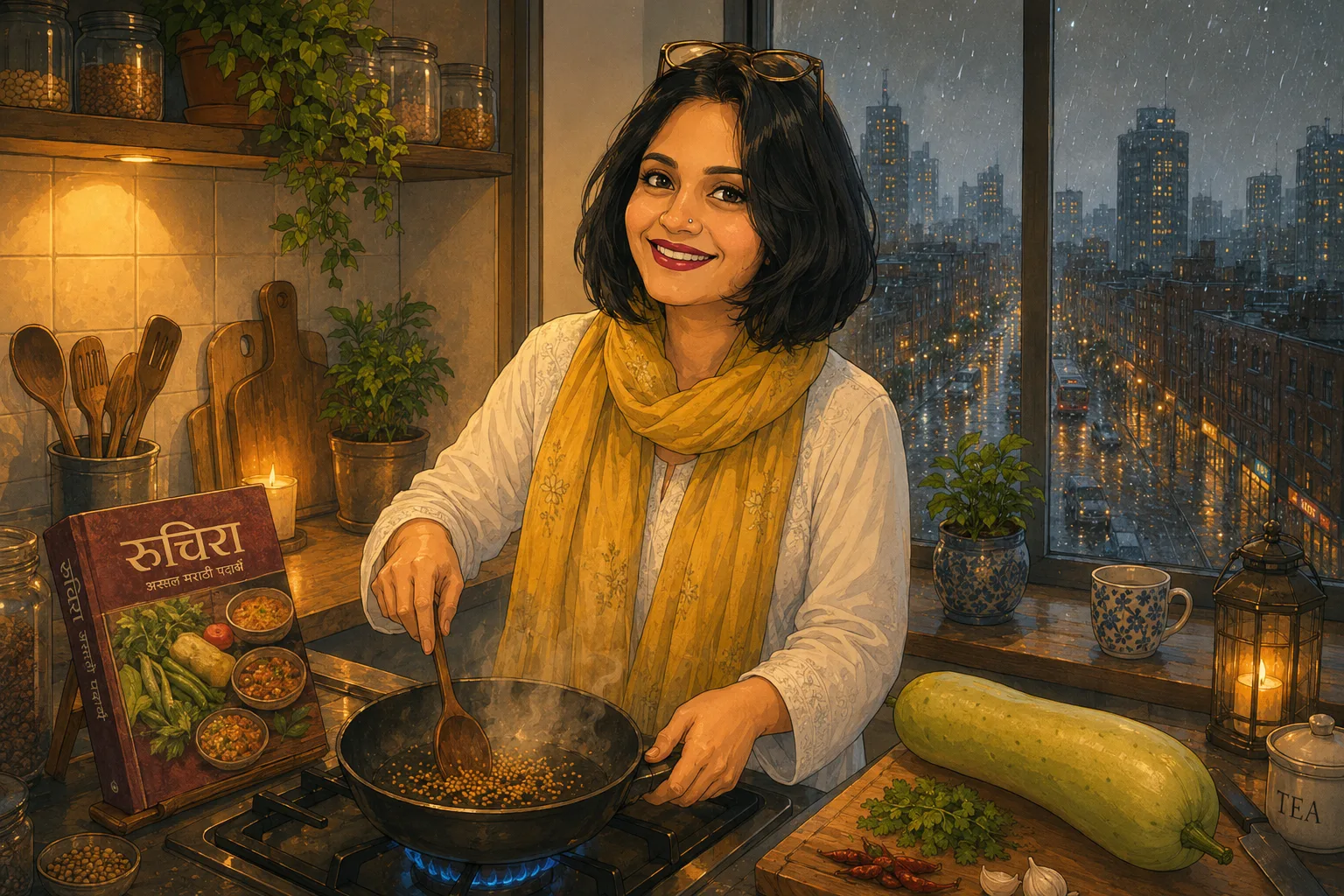
There is a particular kind of longing that settles into the bones of every Indian family living abroad — not a sharp, dramatic ache, but a quiet, persistent one. It surfaces unexpectedly: in the fluorescent aisles of a British supermarket, scanning shelves of courgettes and parsnips, your heart reaching past them for something that smells of home. For us, a Maharashtrian family rooted in the rhythms of Sale in Greater Manchester, that longing often takes the shape of a vegetable.
So when I spotted a plump, pale dudhi — bottle gourd, for the uninitiated — at a South Asian grocer on my weekend trip, I felt the small, private thrill that only an immigrant cook will truly understand. I brought it home like a trophy.
But dudhi sabji, as we usually make it, had begun to feel like a road too well-travelled. Familiar, comforting, yes — but I wanted something different. Something that would make the humble gourd feel like a discovery again. I wanted to shake off the same old same old.
That is when I reached for Ruchira.
My husband had just returned from a trip back to India, and tucked among his luggage — more precious to me than any souvenir — was my copy of Ruchira. To anyone unfamiliar with Maharashtrian culture, it might appear to be simply a cookbook. A modest volume, perhaps, nothing that announces itself with glossy photographs or fashionable fonts. But to a Maharashtrian woman, Ruchira is something else entirely. It is a grandmother, pressed between two covers.
Written by the remarkable Kamlabai Ogale and first published in the mid-1900s, Ruchira has journeyed through generations of Maharashtrian households the way certain recipes do — not written down so much as absorbed, becoming part of who you are. It has been gifted to brides as part of their trousseau, passed from mother to daughter like a quiet act of inheritance. My own mother received her copy that very way — a gift from her mother, tucked into the folds of her new married life as if to say, you will need this, and it will never let you down.
I remember, as a little girl, watching my mother on her weekly day off — that one precious island of rest in an otherwise busy week — bent over the kitchen stove with Ruchira propped open beside her, making sweets with a focus and a tenderness that felt almost ceremonial. The book was already worn at the spine by then, its pages soft with use. It did not merely contain recipes. It held the logic of an entire culinary world.
And so, faced with my dudhi and my desire for something new, I did what generations of Maharashtrian women have done before me: I turned to the old faithful.
Ruchira guided me to a dudhi-moong dal sabji — a dish that paired the gentle, cooling sweetness of bottle gourd with the earthiness of split green lentils, seasoned with a tempering of mustard seeds, curry leaves, and the kind of careful spicing that makes simple food feel deeply nourishing. It was exactly what a nippy evening in Manchester needed. My family ate it with rice, and for a little while, the grey outside the window ceased to matter.
Life in the UK is full of small rituals we have built to keep home alive. There is the crackle of Hindi film music playing on a Sunday morning, filling the kitchen with the golden age of Bollywood. There is the drive to Southall — that magnificent, chaotic, wonderful stretch of West London — for a plate of chaat so good it makes you close your eyes. There is Balaji Temple in Birmingham, where stepping through the doors feels like stepping across a continent. These are the anchors we cast to stop ourselves from drifting too far from who we are.
And then there is Ruchira.
It has been over thirty years since I last had a grandmother to call — that instinctive, irreplaceable recourse of every cook who has ever stood helplessly over a pot, phone in hand, dialling the one person who would know. But Kamlabai Ogale, with her quiet mastery and her gift for making the everyday sacred, has filled that silence. She is the grandmother not just of one household, but of countless Maharashtrian women scattered across the world — in Manchester, in Melbourne, in Toronto — who open her book not just for a recipe, but for comfort. For continuity. For the feeling of hands older and wiser than their own, guiding them gently back to where they belong.