There are women who talk about having a voice, and then there are women who simply have one — sharp, unhesitating, and wrapped in just enough wit to make you laugh before you realise you've witnessed something quietly remarkable. My mother is the latter.
Within our family, among her friends, and across decades of colleagues, Aai has always been known for her quick wits. It is perhaps her most defining quality — not the first thing you notice, but absolutely the last thing you forget.
The first thing you do notice is how effortlessly beautiful she is. Thick, curly hair that seemed to have a personality of its own, a petite frame that carried itself with quiet confidence, and warm olive skin — she was undeniably one of the lookers in our family. But more than her appearance, what drew people to her was her ease with the world. She made friends the way some people collect stamps — naturally, enthusiastically, and with the intention of keeping them forever. Aai doesn't just make friends; she invests in them, tends to those bonds across years and distances, showing up reliably in ways that have made her a cornerstone in the lives of many.
And then, somewhere between the warmth and the laughter, the uninitiated would encounter it — the perfectly timed zinger, the raised eyebrow, the sarcasm delivered so smoothly it would take a beat to land. For the newly acquainted, it always came as a delightful surprise. For those of us who grew up in that house, it was simply the background music of our childhood.
My parents' constant banter was the soundtrack of our upbringing — a daily performance of push and pull, wit traded for wit, that kept all three of us sisters endlessly entertained. My father, bless him, has been Aai's most devoted audience and most frequent target in equal measure.
Now, there is one evening in particular that has become legend in our household.
When Aai went through menopause, her hair — that glorious, signature hair — went through its own quiet rebellion. The texture changed entirely. It became unruly, rough at the ends, a little frayed no matter how lovingly she tended to it. For a woman who had always taken quiet pride in her appearance, it was one of those small, invisible griefs that come with getting older — the kind that nobody around you quite acknowledges.
My father, bless him again and also not at all, came home from work one evening, took one look at her hair, and said — with the breezy confidence of a man who has never once feared consequences — "Why does your hair look like this? Have you not combed or oiled it?"
Now, here is what made it extraordinary: Aai said nothing.
Those of us who know her were immediately on high alert. Silence from her is not peace — it is preparation. She simply turned back to what she was doing: finishing dinner, watching her evening serials, going about her world with the unhurried calm of someone who has already decided exactly what she is going to do and is simply waiting for the right moment.
That moment came at the dinner table.
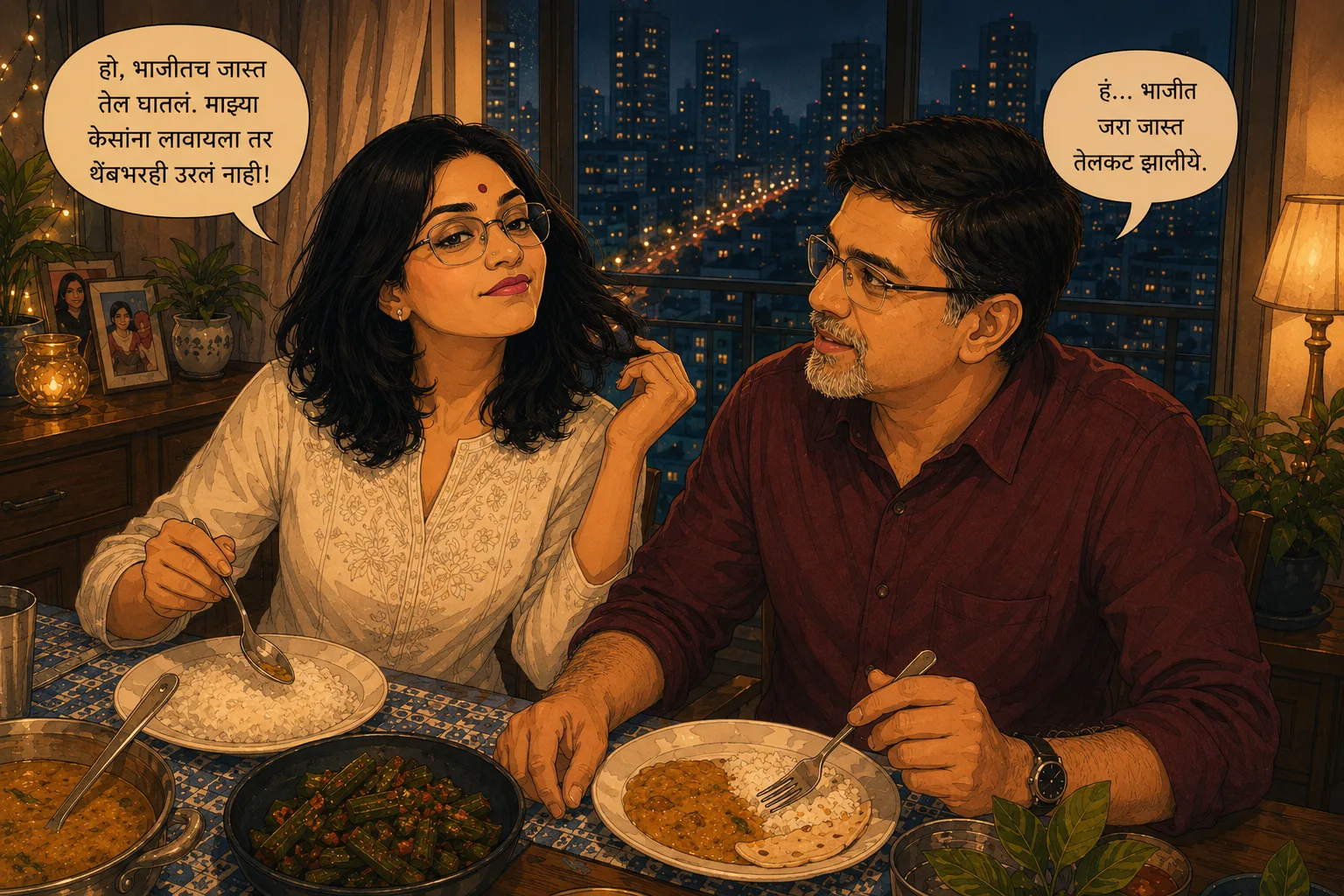
My father, apparently having learned nothing from the first strike, looked at the vegetable curry and remarked, in that same conversational tone, "Have you started making the veggies a little oily, maybe?"
She didn't even put her spoon down.
"Yes," she said, without missing a single beat, "I put too much oil in the food — leaving none for my hair."
We nearly sprayed our entire mouthful across the table.
My sisters and I grew up, went out into the world, and heard phrases like women's empowerment and finding your voice — spoken at conferences, printed on tote bags, hashtagged into the void. And every single time, I have thought of Aai.
Not because she ever marched or proclaimed or made grand statements about what women deserve. But because she simply lived it — with an unshakeable sense of self, a refusal to shrink, a career she built with her own hands, friendships she nurtured with intention, and a wit so precise it could cut glass and make you laugh doing it.
She raised three daughters who watched her every single day. We watched how she held her ground without raising her voice. We watched how she balanced the softness of deep care with the steel of self-respect. We watched how she could silence a room with a single sentence and then go right back to serving dinner. Without a single lesson or lecture, she showed us what it looked like to be fully, unapologetically yourself.
We didn't need a curriculum. We had Aai.
And somewhere in the retelling of that perfectly timed oil joke — in the laughter that still erupts every time one of us brings it up — lives the real inheritance she has passed on to us: the knowledge that a woman with a quick mind, a generous heart, and the courage to use her voice is a force entirely unto herself.