I grew up in Panvel, a scrappy, sun-baked town on the outskirts of Mumbai — one of the great, chaotic, magnificent cities of India. This was the 1980s. No mobile phones, no internet, no screens to disappear into. Life was loud and immediate, and summer holidays felt infinite.
The best of those summers were spent an hour away from home, in the town of Uran, at my grandparents' house.
Aaji — my grandmother — and Ajoba — my grandfather — lived in a sprawling, detached house that felt, to seven-year-old me, like an entire kingdom. My uncle and aunt lived there too, along with their children, Sarini and Satish. When my two sisters, Swati and Preeti, and I arrived for the school holidays, we were joined by our cousins Gagan dada and Aarav from Uncle Appa's side. Ten people under one roof — the house didn't just feel full, it hummed.
The garden was the heart of everything. It wrapped around the house on all sides, wild and generous: Parijat trees dropping their tiny orange-stemmed blossoms at dawn, Champa trees heavy with waxy white flowers, and Ghaneri — that tough, cheerful wildflower that grows everywhere along the Maharashtra coast — spilling colour into every corner. Roses climbed wherever they pleased.
Aaji and Mami fed us like it was their life's mission. Every morning, after we'd showered and tumbled downstairs in a tangle of damp hair and noise, Aaji would have steaming plates of poha or upma waiting — soft, perfectly seasoned, fragrant with mustard seeds and curry leaves. To this day, I've never tasted better.
With full stomachs and nowhere to be, we invented our days from scratch. Board games on the veranda, elaborate pretend-plays that spanned multiple rooms, archaeological expeditions in the garden flower beds. The oldest of us was fourteen, the youngest, seven — an age range that should have meant constant conflict but somehow only added to the chaos and the fun. We were, quite simply, a gang.
Satish was the ringleader of mischief. Inventive, dramatic, utterly fearless — he could turn anything into an event.
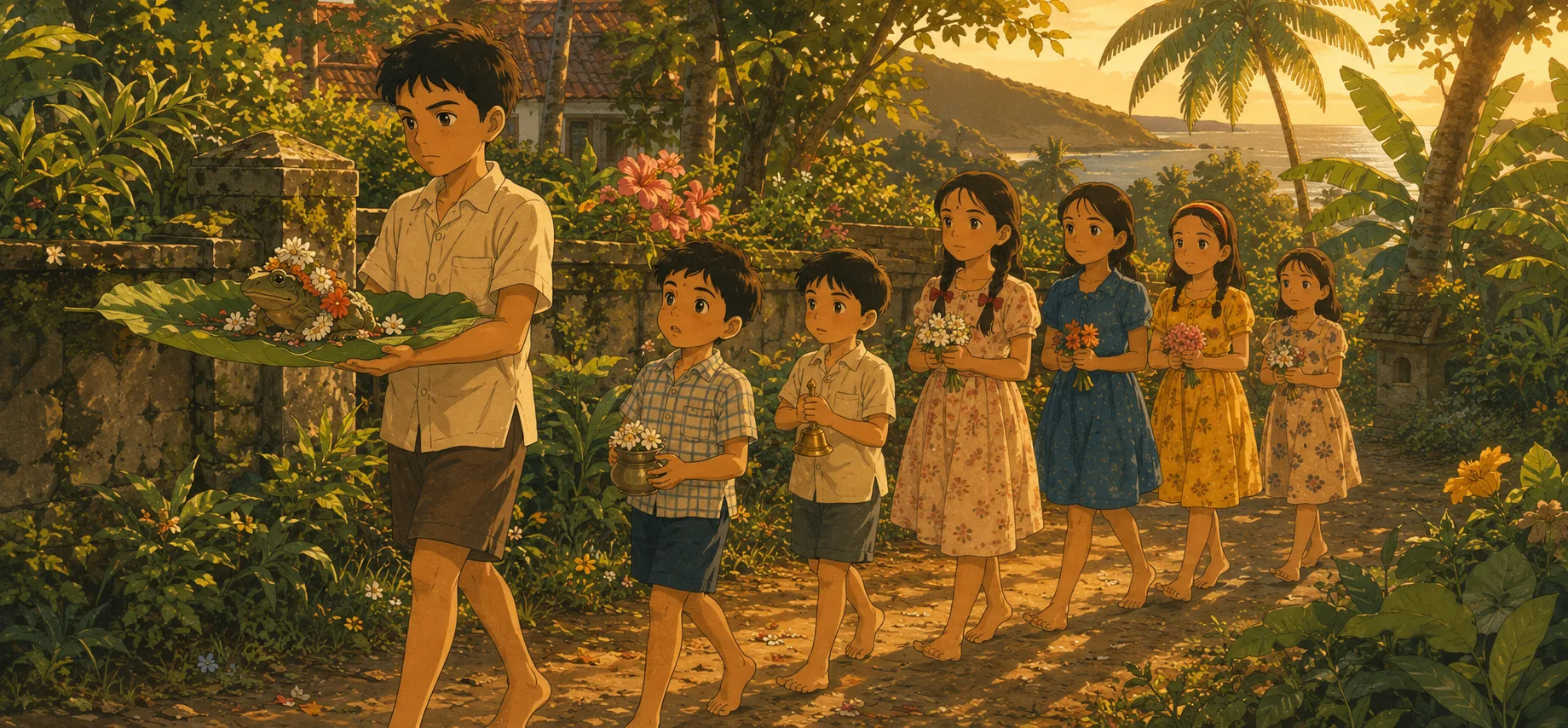
One afternoon, he found a dead frog at the edge of the garden. Any other child might have recoiled or ignored it. Satish looked at it with solemnity and announced that it deserved a proper funeral.
We searched until we found the largest, most dignified leaf available and laid the frog upon it. Ghaneri flowers were gathered and arranged carefully over the body. Then Satish took his place at the front of the procession — the leaf held reverently before him like an offering — and the rest of us fell in behind, faces arranged in suitable expressions of mourning.
We walked in slow, ceremonial loops around the house, chanting Ram naam satya hain — God's name is the only truth — the phrase murmured at real funerals, now delivered with complete sincerity by a gang of children following a flower-covered frog around a garden in coastal Maharashtra. It was absurd. It was perfect.
Someone dug a small grave in the backyard. The frog was lowered in with full honours. More Ghaneri flowers were laid over the freshly turned earth. We stood back, satisfied. We had done right by the frog.
But the frog funeral, memorable as it was, isn't the story that stays with me most from those Uran summers. That honour belongs to the cockerel.
Ajoba discovered it one morning — a dead cockerel, lying stiff in the garden like an accusation. It belonged to the neighbour, who kept a noisy, free-ranging flock of hens and cockerels that had a habit of wandering into our garden and demolishing Ajoba's beloved plants. This was a long-running source of fury. Ajoba had argued with the neighbour about it more times than any of us could count.
Now here was a dead cockerel on his property.
He was furious — and, for perhaps the first time in his life, nervous. If the neighbour found out, who would believe it was a coincidence? It would look like revenge. The sort of story that spreads through a small town and sticks forever.
Before Ajoba could think clearly, Satish came thundering through the house. "Dead cockerel! Dead cockerel!" he announced to anyone within earshot, which was everyone, because Satish had only one volume. The telling-off he received was swift and thorough.
Ajoba, once he'd restored order, came to find me. Of all his grandchildren, he had decided I was the most trustworthy — the one least likely to broadcast family business to the neighbourhood. He pulled me quietly aside. "We are going to dig a hole in the garden," he said, in a tone that brooked absolutely no discussion, "bury the thing, and no one needs to know."
I fetched the spade and plough from the shed. We began to dig. Within minutes, every single one of my siblings and cousins had materialised silently on the porch, drawn by some sixth sense for spectacle, watching with wide, fascinated eyes. Ajoba spotted them. Without breaking his digging rhythm, he turned and shooed them away with the authority of a man who has never once in his life been disobeyed — at least, not visibly.
They shuffled off the porch. Ajoba kept digging until the hole was deep enough, lowered the cockerel in, and covered it without ceremony. The matter was closed.
It was not, however, forgotten.
Once I'd washed up and rejoined the gang, I found Satish incandescent. He had convened an unofficial meeting on the far side of the garden, away from adult ears, and was making the case — passionately, at length — for open revolt. Ajoba had dismissed them like children. (To be fair, we were children, but that was beside the point.) Something had to be done.
The revolution, as it turned out, never got off the ground. Ajoba ruled that house with an iron fist. We all knew it. Even Satish, when pressed, had to concede that any uprising would have been put down before it drew its first breath.
The dead cockerel stayed buried. The rebellion stayed a dream. And Uran, that summer, stayed the most alive place in the world.