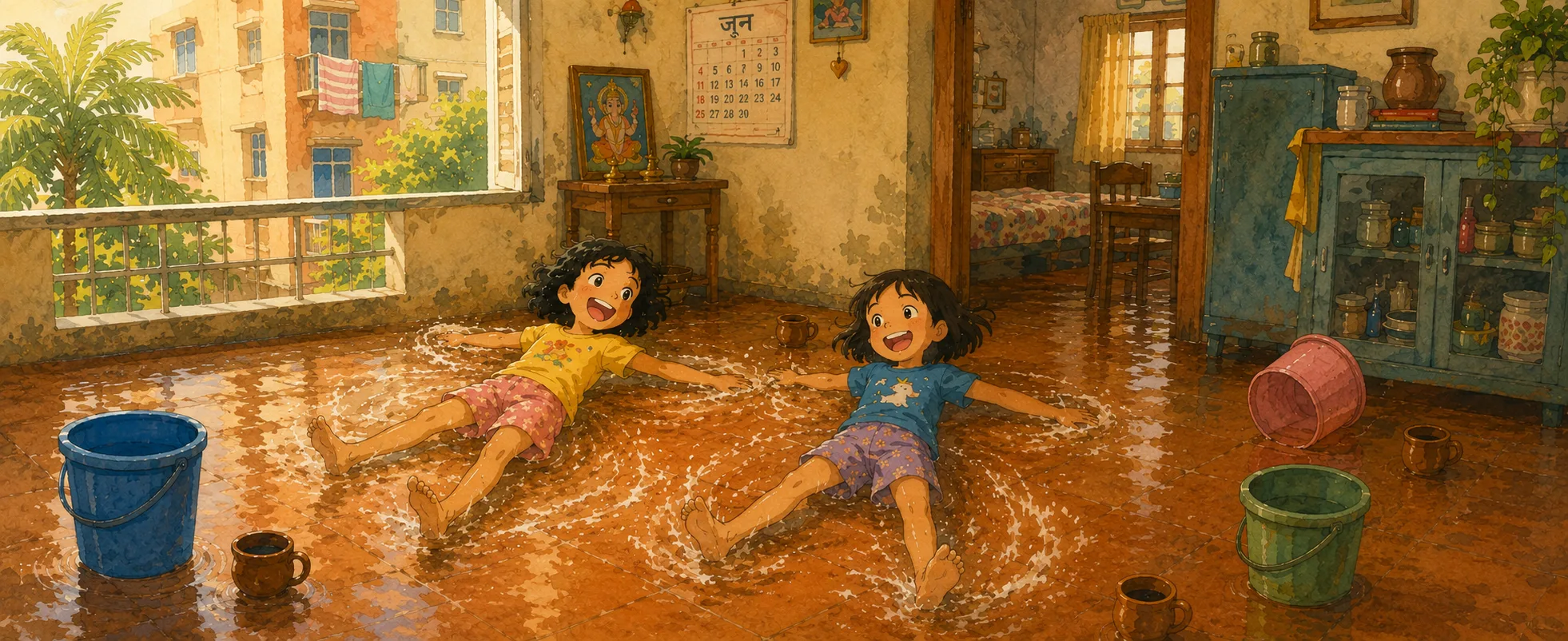
It was a quiet afternoon. The kind of quiet that, looking back, should have come with a warning label.
Aaji — our grandmother — was fast asleep, taking her serious post-lunch nap. In our house, Aaji's nap was treated like a sacred event. You did not bang doors. You did not shout. You basically tiptoed around like a cartoon burglar until she woke up.
I was eight, lying on the bed with a book, feeling very grown-up and smart. My sisters Swati (five) and Preeti (three) were "playing," which is what small kids call it when they're actually planning a disaster.
Then I heard it. Splash. Water. From the bathroom.
Now, a responsible older sister would have jumped up to check. I was not that sister. I turned the page and waited to see what would happen next. (Spoiler: a lot.)
A minute later, Swati and Preeti went marching past my door. Each of them was carrying a mug full of water, holding it like they were transporting treasure. They walked solemnly to the living room and tipped the water onto the floor. Then they marched back to the bathroom. Refilled. Repeated.
A bit of background: back then, our city's water supply only came on for two hours in the morning and two hours in the evening. So our bathroom was packed with buckets and drums of water that we stored up like squirrels storing nuts for winter. To my sisters, though, this was not "emergency water." This was raw material.
Mug after mug, they emptied the buckets onto the terracotta floor. The water spread out in a shiny puddle, then a small lake, then — let's be honest — a swimming pool. Our family did not own a swimming pool. We barely owned a balcony. But my sisters had decided that this was about to change.
And then, with the calm confidence of Olympic athletes, they lay down on the wet floor and began doing snow angels.
I peeked over my book. I couldn't help it. Swati was doing what she clearly believed was a breaststroke, arms flapping, looking like a very confused frog. Preeti was doing something halfway between a doggy paddle and a small, wet prayer. They were squealing with joy. They had built themselves a pool, and they were swimming.
It was, I have to admit, the funniest thing I had ever seen.
That's when Aaji woke up.
Aaji didn't wake up gently. Aaji woke up like someone activating a security system. She sat up, blinked once, and took in the scene: two wet children doing the backstroke across the living room. She made a sound. Not a word — just a sound — the kind grandmothers make when they realise the kids have lost their minds.
The swimmers did not notice. They were mid-lap.
Aaji moved fast. She grabbed Preeti first because Preeti was closer. Swati got caught two seconds later. Both of them got the scolding of their short lives, and let's just say Aaji's slipper made an appearance. I got in trouble too — for not stopping them. I had my reasons. My main reason was that it was incredible, and I would not have stopped it for a million rupees. But saying that out loud seemed like a bad idea, so I just looked guilty and stared at my book.
You'd think I'd learn my lesson. You would be wrong.
Two years later. New apartment. Diwali holidays. Same energy.
We had moved into our own place in a neighbourhood called Bageshri, and my cousins were over for Diwali. It was, once again, afternoon. Aaji was, once again, asleep — this time on the divan in the living room.
The rest of us — Gagan dada (the oldest cousin and unofficial team captain), Satish, Sarini, Swati, Preeti, and I — were sitting on the bedroom floor, whispering. Six kids, one closed door, one sleeping grandmother. What could go wrong?
And then I had The Idea.
"Guys," I whispered, eyes shining. "What if we sat around a bonfire?"
In my head, this was a beautiful plan. We'd sit in a circle around a cosy little fire, tell stories, maybe sing songs, and bond as cousins. It would be magical. It would be like a movie. In real life, what I was suggesting was: let's light a fire. Indoors. On the floor. Next to a sleeping grandmother. In an apartment. Everyone thought it was an excellent plan.
We sprang into action. Old newspapers were gathered. We tore them into neat strips like we were doing arts and crafts. We made a little pile in the middle of the bedroom floor. I tiptoed to the kitchen and came back with a matchbox, which I handed to Gagan dada — partly because he was the oldest, and partly because some part of my brain knew that if this went wrong, "Gagan dada lit the match" was a good sentence to have ready.
He struck the match. He dropped it on the pile. Whoosh. A small, cheerful flame popped up in the middle of our circle. We were thrilled. We felt like explorers. Like grown-ups. Like the cool kids in a movie sitting around a campfire.
But after a minute, I felt the bonfire needed something more. More drama. More crackle. So I went and got the leftover roll caps from our Diwali firecrackers — those little red rolls with tiny dots of gunpowder that pop when you smack them with a stone. I sat down very seriously, separated each red dot, and started feeding them into the fire one at a time. Pop. Pop. Pop. The bonfire crackled. My cousins gasped. I felt like a genius. A small, dangerous, ten-year-old genius.
What we did not notice, in our crackling glory, was that Preeti had quietly slipped out of the room. Preeti, age five, had gone to Aaji. Preeti had informed.
Aaji walked in like she already knew everything — because, thanks to Preeti, she did. She looked at the fire. She looked at the gunpowder. She looked at the six children frozen mid-crime. And then she did what Aaji always did: she grabbed Swati. Because Swati was nearest. Again.
Swati, who hadn't lit the match. Swati, who hadn't even brought the roll caps. Swati, whose only crime in life seemed to be standing too close to whatever I had set on fire.
Swati got it. The rest of us got yelled at. We were given buckets and rags and made to scrub the floor, which now had a black burn mark on the tile — a beautiful little souvenir of my "cosy bonfire" idea.
When my father came home from work that evening, Aaji met him at the door and announced, very calmly, that she was done. She had served her sentence. She had babysat through floods and fires. Someone else would have to look after us, because she was officially retiring.
We got another scolding from our parents. But here's the best part — not a single cousin told on me. Not Gagan Dada, who could have. Not Satish, not Sarini, not even Swati, who had now been beaten twice in two years for my brilliant ideas. Nobody pointed a finger. The code held.
Well. Almost. Because, of course, there was Preeti. Sweet little Preeti. Big innocent eyes. Tiny voice. Three years old in the swimming pool. Five years old at the bonfire. And already, very clearly, the mole in our gang.